
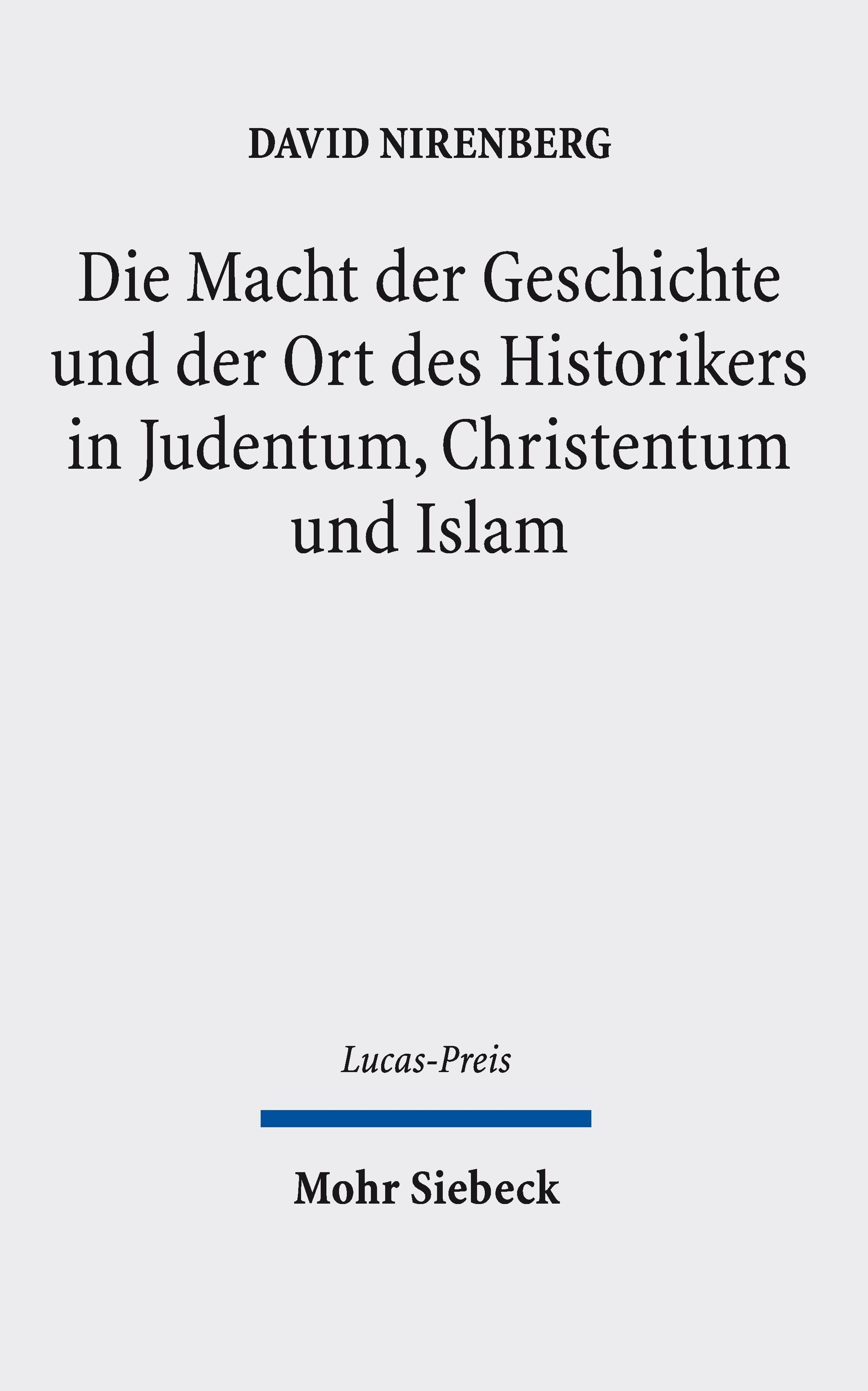
David Nirenberg: Die Macht der Geschichte und der Ort des Historikers in Judentum, Christentum und Islam, Gebunden
Die Macht der Geschichte und der Ort des Historikers in Judentum, Christentum und Islam
Sie können den Titel schon jetzt bestellen. Versand an Sie erfolgt gleich nach Verfügbarkeit.
- Herausgeber:
- Birgit Weyel
- Übersetzung:
- Isabel Eiselt
- Verlag:
- Mohr Siebeck GmbH & Co. K, 11/2026
- Einband:
- Gebunden
- Sprache:
- Deutsch
- ISBN-13:
- 9783162007087
- Artikelnummer:
- 12923355
- Umfang:
- 196 Seiten
- Erscheinungstermin:
- 30.11.2026
- Serie:
- Lucas-Preis
- Gesamtverkaufsrang: 7264
- Verkaufsrang in Bücher: 182
Klappentext
David Nirenberg suggests that Judaism, Christianity, and Islam are historical religions: traditions in which the past serves not merely as a record of revelation but as an enduring source of theological knowledge and moral orientation which grounds competing visions of salvation. Building on this claim, he develops the concept of co-produced religions, demonstrating that these traditions have always constituted and re-constituted themselves through their interpretations of one another and of their shared historical inheritance. Through close readings of scripture, theology, philosophy, and a wide-ranging set of historical case studies, the author demonstrates how historical interpretation generates both new forms of religious identity and (putatively) secular forms of critical thought. He argues that historians, like prophets, inevitably interpret the past in light of imagined futures, while the futures communities imagine are themselves shaped by the histories they construct. Rather than treating history as either deterministic or disconnected, the author presents historical interpretation as an arena of enduring human creativity in which theology, politics, and historical scholarship remain mutually inextricable. The historical archive is therefore not a fixed repository of precedent but an inexhaustible reservoir of possibilities through which believers, theologians, and historians continually reshape the meaning of Judaism, Christianity, and Islam. By bringing historical inquiry into conversation with constructive theology, David Nirenberg offers a new framework for understanding religion, historical consciousness, and the continuing power of the past to shape both thought and action.
Anmerkungen:
Bitte beachten Sie, dass auch wir der Preisbindung unterliegen und kurzfristige Preiserhöhungen oder -senkungen an Sie weitergeben müssen.